

Solar Activity and its Impact on Human Civilization
- 自然界の多くの現象には周期がある。その周期の影響を受けて様々な活動が変化している。
03-01: Numerous phenomena in the natural world exhibit cyclic patterns. Influenced by these cycles, various activities undergo continuous shifts.
- 自然界の周期には、短期・中期・長期の様々な時間スケールがあり、それらが重なり合うことで、自然界の活動は複雑に変化している。
03-02: Cycles in the natural world span various time scales—short, medium, and long term. As these cycles overlap and interfere with one another, the activities of the natural world undergo complex variations.
- 太陽系においては、太陽の活動周期が惑星の自然環境に影響を及ぼしていると考えられる。従って、我々人類の活動も太陽活動の周期に影響を受けていると推察されるのである。
03-03: Within the solar system, the cycle of solar activity is considered to exert a direct influence on the natural environments of its planets. Consequently, it is inferred that our human activities are likewise influenced by the periodic cycles of solar activity.
- 太陽活動は、太陽黒点などの直接観測によって把握できる。また、樹木年輪などに残された放射性炭素(¹⁴C)の変化を調べることによって、過去の太陽活動を間接的に復元することもできる。
03-04: Solar activity can be comprehended through direct observations, such as counting sunspots. Furthermore, by analyzing fluctuations in radiocarbon (¹⁴C) preserved in tree rings, past solar activity can also be reconstructed indirectly.
- 放射性炭素の長期的変化は、過去12000年までさかのぼることができる。
03-05: Long-term fluctuations in radiocarbon (14C) can be traced back up to 12,000 years into the past.

- 過去12000年前から9000年前にかけて空気中の放射性炭素が減少していることから、この時期に太陽活動が活発化した可能性が考えられる。また、この時期には地球の気候が温暖化し、極地方を含む大規模な氷床が融解して海面が上昇したことが知られている。これらの現象の間には、太陽から地球に届くエネルギーや地球環境の変化を介した関係が存在した可能性がある。
03-06: The decrease in atmospheric radiocarbon (14C) between 12,000 and 9,000 years ago suggests that solar activity likely intensified during this period. Furthermore, it is well established that during this same timeframe, the Earth’s climate warmed, leading to the large-scale melting of ice sheets—including those in polar regions—and a subsequent rise in sea levels. A fundamental interrelationship likely existed among these phenomena, mediated by changes in the energy reaching the Earth from the Sun and the corresponding transformations in the terrestrial environment.
- 地球の自転による遠心効果は赤道付近で最も強く、地球や海水の分布にも影響を与えている。そのため、氷床の融解による海面上昇についても、地球の自転による遠心効果によって赤道方面でより大きく現れる可能性がある。
03-07: The centrifugal effect resulting from the Earth’s rotation is strongest near the equator, exerting a significant influence on the distribution of both the Earth’s solid shape and its ocean waters. Consequently, regarding the sea-level rise caused by the melting of ice sheets, it is plausible that the impact would manifest more prominently in the equatorial region due to this rotational centrifugal effect.
- 約9000年前から約8000年前にかけては、大気中の放射性炭素が増加する傾向が見られる。この変化は太陽活動の弱まりと整合するが、地球磁場や炭素循環などの影響も考慮する必要がある。この時期には、一部の地域で海面上昇の停滞や一時的な海退が認められる。その後、約8000~7000年前から海面上昇が再び進み、約7000~6000年前には縄文海進が顕著になった。瀬戸内海などでは、海面上昇によってかつての河谷や低地が海水に覆われ、現在の海域へと変化していった痕跡が残されている。
03-08: Between approximately 9,000 and 8,000 years ago, a trend toward an increase in atmospheric radiocarbon (14C) is observed. While this change aligns with a weakening of solar activity, it is also necessary to consider other influencing factors, such as the Geomagnetic field and the carbon cycle. During this period, a stagnation in sea-level rise and a temporary marine regression are recognized in certain regions. Subsequently, from about 8,000 to 7,000 years ago, sea-level rise resumed, and by approximately 7,000 to 6,000 years ago, the Jomon Transgression became pronounced. In areas such as the Seto Inland Sea, traces remain showing that former river valleys and lowlands were submerged by seawater due to this rise, transforming them into the maritime regions we see today.

- 約1500年前から約400年前にかけて、大気中の放射性炭素には増加傾向が見られ、過去の太陽活動が低下していた可能性が示される。この期間にはウルフ極小期、シュペーラー極小期、マウンダー極小期、ダルトン極小期など、複数の太陽活動極小期が存在した。これらの時期の一部は小氷期の寒冷化と重なっており、太陽活動の周期的な変動が地球の気候変動に影響を与えた可能性が考えられる。ただし、小氷期の形成には火山活動や海洋・大気循環など、太陽活動以外の要因も関与したと考えられている。
03-09: Between approximately 1,500 and 400 years ago, an increasing trend in atmospheric radiocarbon (14C) is observed, indicating the possibility that solar activity had declined in the past. During this timeframe, multiple grand solar minima occurred, including the Wolf Minimum, Spörer Minimum, Maunder Minimum, and Dalton Minimum. Some of these periods coincided with the cooling of the Little Ice Age, suggesting that periodic variations in solar activity likely influenced Earth’s climate change. However, it is also considered that factors other than solar activity—such as volcanic activity and ocean-atmosphere circulation—contributed to the formation of the Little Ice Age.
- 約300年前のマウンダー極小期以降、太陽活動は11年周期などの変動を繰り返しながら、長期的にも変化してきた。大気中の放射性炭素(¹⁴C)の変化は、その太陽活動を過去にさかのぼって推定するための重要な指標の一つである。ただし、¹⁴Cの変動には地球磁場や炭素循環などの影響も含まれているため、太陽活動だけで説明することはできない。近代以降、地球は温暖化し、それに伴って氷河・氷床の融解や海水の熱膨張による海面上昇が進んでいる。太陽活動の変動は地球の気候に影響を与える自然要因の一つであるが、近代の温暖化には人為的な温室効果ガスの増加など、複数の要因が関与している。こうした太陽活動の変動と地球環境、人類文明の変化との関係をさらに考察する必要がある。
03-10: Since the Maunder Minimum approximately 300 years ago, solar activity has varied over the long term while continuously repeating cycles, such as the 11-year cycle. Variations in atmospheric radiocarbon (¹⁴C) serve as one of the key indicators for reconstructing past solar activity. However, because ¹⁴C fluctuations also incorporate effects from the Geomagnetic field and the carbon cycle, they cannot be attributed solely to solar activity. In modern times, the Earth has experienced warming, accompanied by a rise in sea levels driven by the melting of glaciers and ice sheets, as well as the thermal expansion of seawater. While variations in solar activity represent a natural factor influencing Earth’s climate, modern global warming involves multiple factors, including anthropogenic increases in greenhouse gases. It is imperative to further examine the relationships among these variations in solar activity, the terrestrial environment, and changes in human civilization.
- 過去12,000年間の大気中の放射性炭素(¹⁴C)の変化を考察すると、数千年規模の変動が認められる。特に約300年前から現在にかけて見られる¹⁴Cの減少傾向は、約12,000年前の変化と類似しているようにも見える。このことから、現在の太陽活動が長期的な活動期に入っている可能性も考えられる。ただし、¹⁴Cの変動には太陽活動だけでなく、地球磁場や炭素循環などの影響も含まれているため、この類似性だけから数千年周期の太陽活動を確定することはできない。近代の地球温暖化については、産業革命以降の温室効果ガスの増加が主要な要因として認められている一方、太陽活動も自然変動の一因として検討する必要がある。過去の太陽活動極小期と寒冷期が重なる事例を考慮すれば、太陽活動が長期的に活発化した場合の地球環境への影響についても検証する必要がある。もし現在が数千年規模の太陽活動の長期活動期に相当するなら、その影響が今後どの程度の期間継続するのかは重要な研究課題となる。
03-11: Examining variations in atmospheric radiocarbon (¹⁴C) over the past 12,000 years reveals fluctuations occurring on a multi-millennial scale. In particular, the declining trend of ¹⁴C observed from approximately 300 years ago to the present appears similar to the pattern seen around 12,000 years ago. This similarity suggests the possibility that current solar activity has entered a long-term active phase. However, because ¹⁴C fluctuations incorporate effects not only from solar activity but also from the Geomagnetic field and the carbon cycle, a multi-millennial solar cycle cannot be conclusively determined based solely on this similarity. Regarding modern global warming, while the post-Industrial Revolution increase in greenhouse gases is recognized as a primary driver, variations in solar activity must also be evaluated as a contributing natural factor. Considering past instances where grand solar minima coincided with cooling periods, it is necessary to examine the potential impacts on the terrestrial environment should solar activity remain heightened over the long term. If the present era indeed corresponds to a multi-millennial long-term active phase of solar activity, determining the duration over which its effects will persist represents a crucial research challenge.

- 太陽活動の変化は、太陽黒点数の変化と密接に関係している。ベルギー王立天文台SILSOがまとめている1700年以降の国際黒点数の長期系列を分析すると、約11年周期で黒点数が増減することが明瞭に確認できる。また、個々の11年周期の強さにも長期的な変動があり、約100年規模で強い周期と弱い周期がまとまる傾向が認められる。これは一般にグライスベルク周期として知られている。すなわち、太陽活動には短期的な約11年周期と、それをゆっくり変化させる約100年規模の変動が重なっていると考えることができる。
03-12: Changes in solar activity are closely linked to variations in sunspot numbers. Analyzing the long-term international sunspot number series since 1700 compiled by SILSO at the Royal Observatory of Belgium clearly confirms that sunspot numbers increase and decrease in cycles of approximately 11 years. Furthermore, long-term fluctuations are observed in the intensity of individual 11-year cycles, displaying a distinct tendency for stronger and weaker cycles to cluster over a century-scale timeframe—a phenomenon broadly recognized as the Gleissberg cycle. In other words, solar activity can be understood as an overlapping structure composed of short-term 11-year cycles modulated by slow, century-scale variations.

< data: https://www.sidc.be/silso/home >
- 第2章「神々の実相論」で説明したが、岡田茂吉師は、1931年までの約3000年間を「夜の時代」とし、1931年6月15日を境に「昼の時代」へ転換したと教えられている。また、「昼間の世界ということは黒点が変化するのです」と述べ、太陽黒点を太陽活動の変化を示す重要な現象として捉えている。
現代の太陽物理学においても、太陽黒点は太陽の磁気活動を示す代表的な指標であり、約11年周期で増減することが確認されている。また、個々の11年周期の活動強度にも長期的な変動が認められる。そこで、1700年以降の太陽黒点活動の変化を、岡田師が説いた「夜昼転換」との関係から考察すると、1931年以降の太陽活動の変化が、「昼の時代」の一つの自然科学的な表れ(黎明期)として対応している可能性も考えられる。
ただし、1931年6月15日に太陽活動そのものが物理的に転換したことが科学的に確認されているわけではない。また、現在が数千年規模の太陽活動の長期活動期に入ったことも確定していない。したがって、1931年以降の太陽活動と「昼の時代」との関係は、今後の太陽活動の長期的変化を観測することによって検証すべき仮説として捉える必要がある。
03-13: As explained in Chapter 2, ‘Theory of the True Nature of the Divine,’ Master Okada_Mokichi taught that the approximately 3,000 years leading up to 1931 constituted the ‘Age of Night,’ and that a transition to the ‘Age of Day’ occurred on June 15, 1931. Furthermore, he stated, ‘The world of daytime means that sunspots change,’ recognizing solar sunspots as a crucial phenomenon reflecting variations in solar activity.
In modern solar physics as well, sunspots are confirmed as a representative indicator of the Sun’s magnetic activity, increasing and decreasing in cycles of approximately 11 years, with long-term variations also recognized in the intensity of individual cycles. Examining changes in sunspot activity since 1700 in relation to the ‘Transition from Night to Day’ taught by Master Okada_Mokichi suggests the possibility that post-1931 solar activity corresponds to a natural-scientific manifestation (the dawning phase) of the ‘Age of Day.’
However, it has not been scientifically confirmed that solar activity itself physically shifted on June 15, 1931, nor has it been established that the present era has entered a multi-millennial long-term active phase. Therefore, the relationship between post-1931 solar activity and the ‘Age of Day’ must be treated as a hypothesis to be verified through long-term observations of future solar activity.

- 太陽活動が低下したシュペーラー極小期やマウンダー極小期などは、小氷期の寒冷な時期と重なっている。一方、17世紀末から18世紀にかけて太陽活動が回復していく時期には、英国で産業革命が始まり、その後、蒸気機関、電気、通信、輸送、原子力、コンピューターなどの技術が急速に発展し、約250~270年の間に現代文明が形成されていった。このことから、太陽活動と人類文明の発展との間には、何らかの関係が存在する可能性が考えられる。ただし、産業革命や近代文明の発展には、石炭などのエネルギー資源、技術革新、科学思想、教育、社会制度、交易など、多くの要因が関与しているため、太陽活動だけを原因とすることはできない。
本書ではさらに、太陽活動の活発化が地球の物質的環境だけでなく、地球の霊界、すなわち量子情報場にも影響を与え、それによって人類の意識や認識能力が変化する可能性を考察する。「昼の時代」とは、単に太陽の光が強くなるという意味ではなく、これまで見えなかったものが見えるようになり、自然界の「理」を人類がより深く認識できる時代とも解釈できる。その結果として、発明・発見が促進され、科学技術の進歩が加速した可能性について、さらに検討していく必要がある。
03-14: Periods of reduced solar activity, such as the Spörer Minimum and Maunder Minimum, coincide with the cold spell of the Little Ice Age. Conversely, during the period from the late 17th to the 18th century when solar activity was recovering, the Industrial Revolution began in Britain. Subsequently, technologies such as the steam engine, electricity, telecommunications, transportation, nuclear energy, and computing developed rapidly, giving rise to modern civilization over approximately 250 to 270 years. This suggests the possibility of a relationship between solar activity and the advancement of human civilization. However, because the development of the Industrial Revolution and modern civilization involved numerous factors—including energy resources like coal, technological innovation, scientific thought, education, social institutions, and trade—solar activity cannot be identified as the sole cause.
Furthermore, this book examines the possibility that heightened solar activity influences not only Earth’s material environment but also its spiritual realm—namely, its quantum information field—thereby altering human consciousness and cognitive ability. The ‘Age of Day’ does not simply signify an intensification of sunlight; it can also be interpreted as an era in which what was previously invisible becomes discernible, enabling humanity to perceive the underlying laws (‘principle’ or ‘reason’) of the natural world more deeply. Consequently, further investigation is required regarding the possibility that this transformation fostered inventions and discoveries, thereby accelerating scientific and technological progress.

- 一方、世界的な社会変動や大事件についても、約100年規模のグライスベルク周期との時間的な対応を考察することができる。20世紀前半から中頃にかけては太陽活動が比較的活発な時期であり、この時期には第一次世界大戦、第二次世界大戦など、世界史を大きく変える出来事が発生した。太陽活動とこれらの戦争との間に直接的な因果関係が確認されているわけではないが、両者の時間的な対応については、さらに検証する価値がある。
本書では、太陽から地球へもたらされるエネルギーの変化が、物質的な地球環境だけでなく、地球の霊界、すなわち量子情報場にも影響を与える可能性を考えている。その結果、これまで潜在していた情報や社会的問題が顕在化し、既存の価値観や社会構造が変化して、新しい秩序が形成されていく過程を「世界的浄化作用」と捉えることができる。ただし、ここでいう浄化とは戦争や災害そのものを肯定するものではなく、それらの出来事を含む大規模な社会変動の結果として、世界の構造や価値観が変化していく過程を意味するのである。
03-15: Meanwhile, regarding global social upheavals and major historical events, a temporal correspondence with the century-scale Gleissberg cycle can also be considered. The period from the early to the mid-20th century was an era of relatively active solar activity, during which world-altering events occurred, including World War I and World War II. Although a direct causal relationship between solar activity and these wars has not been established, the temporal correspondence between the two warrants further examination.
In this book, we consider the possibility that variations in energy brought from the Sun to Earth influence not only the physical terrestrial environment but also Earth’s spiritual realm—namely, its quantum information field. As a result, previously latent information and social issues become manifest, leading to the transformation of existing values and social structures, and the subsequent formation of a new order—a process that can be conceptualized as ‘global purification.’ However, ‘purification’ in this context does not justify or affirm war or disaster itself; rather, it refers to the process through which global structures and values transform as a result of large-scale social upheavals that encompass such events.

- さらに、1918年には新型インフルエンザによる世界的なパンデミックが発生し、1918~1919年の流行によって、世界で少なくとも約5000万人、研究によっては1億人近くに達した可能性のある死者が出たと推計されている。
このパンデミックは第一次世界大戦と同時期に発生し、戦争による大規模な兵員・人口移動や過密な生活環境が、感染症の世界的な拡大を促進したと考えられている。 また、感染拡大による労働力不足や医療体制への負担などによって、社会や経済にも大きな影響が及んだ。
このように1910年代から1930年代にかけては、第一次世界大戦、世界的な感染症、経済的混乱など、複数の世界的危機が重なり、人類社会の構造を大きく変化させる時代となった。これらの出来事と太陽活動との間に直接的な因果関係が科学的に確立されているわけではないが、本書では、こうした世界規模の危機が集中した時期を、太陽活動の長期変動と地球の量子情報場との関係から考察し、既存の社会構造や価値観が顕在化・変化していく「世界的浄化作用」の一つの現れとして捉えることができるのではないかと考える。
03-16: Furthermore, in 1918, a global pandemic caused by a novel influenza virus broke out. Estimates suggest that the 1918–1919 pandemic resulted in a death toll of at least 50 million worldwide, with some studies indicating it may have approached nearly 100 million.
Occurring simultaneously with World War I, this pandemic was accelerated in its global spread by military mobilization, mass population movements, and overcrowded living conditions resulting from the war. Moreover, the widespread infection imposed severe burdens on healthcare systems and caused labor shortages, exerting a profound impact on society and the economy.
In this manner, the period from the 1910s through the 1930s witnessed an overlap of multiple global crises—including World War I, a global pandemic, and economic turmoil—which dramatically transformed the structure of human society. While a direct causal relationship between these events and solar activity has not been scientifically established, this book posits that this concentration of global crises can be examined through the relationship between long-term variations in solar activity and Earth’s quantum information field, thereby allowing us to interpret it as one manifestation of ‘global purification’ wherein existing social structures and values become manifest and undergo transformation.
- 過去の三大インフルエンザ・パンデミックである1918年のインフルエンザ、1957年のアジア風邪、1968年の香港風邪は、いずれも太陽黒点の約11年周期における活動極大期の近くで発生している。この3例の時間的対応は興味深く、太陽活動周期とインフルエンザの流行時期との間に何らかの関係が存在する可能性を考察することができる。ただし、3例だけでは統計的に十分とはいえず、この対応関係だけから因果関係を確定することはできない。
その後も、2002~2003年にはSARSコロナウイルスによる重症急性呼吸器症候群が国際的に拡大し、約8,000例、約800人の死亡が報告された。また、2014~2016年にはギニアを起点とするエボラウイルス病がシエラレオネ、リベリアなど西アフリカ諸国へ広がり、約2万8,600人が感染し、約1万1,300人が死亡した。 2012年に確認されたMERSコロナウイルス感染症も中東を中心に発生し、その後、他地域への輸出症例や医療施設内での感染が問題となった。 さらに2018~2020年には、コンゴ民主共和国東部で約3,500例、約2,300人の死者を伴う大規模なエボラ流行が発生した。
これらの感染症について、太陽活動との関係が確立されているわけではない。しかし、太陽活動は紫外線、宇宙線、大気環境、気候などを通じて地球環境に影響を及ぼすため、感染症の発生・流行に間接的な影響を与える可能性については、今後も研究する価値がある。
実際、太陽活動とインフルエンザとの関係については、フレッド・ホイル博士とチャンドラ・ウィクラマシンゲ博士が1990年にNature誌に「Sunspots and influenza」という論考を発表している。 一方、この問題については同年のNature誌上でも反論が掲載されており、現在も太陽活動と感染症との因果関係が確立されているわけではない。 したがって、本書ではこの関係を確定した因果関係ではなく、太陽活動と感染症との時間的・環境的関係を検証するための仮説として考察していくのである。
03-17: The three major influenza pandemics of the past—the 11-year solar cycle’s peak activity periods: the 1918 influenza, the 1957 Asian flu, and the 1968 Hong Kong flu—all occurred near the solar maxima. The temporal correspondence among these three cases is intriguing, raising the possibility of a relationship between the solar activity cycle and the outbreak timing of influenza. However, three cases alone are statistically insufficient, and a causal relationship cannot be established based solely on this alignment.
Subsequently, from 2002 to 2003, Severe Acute Respiratory Syndrome (SARS) caused by the SARS coronavirus spread internationally, resulting in approximately 8,000 reported cases and nearly 800 deaths. Furthermore, from 2014 to 2016, Ebola virus disease originating in Guinea spread to West African nations such as Sierra Leone and Liberia, infecting approximately 28,600 people and causing around 11,300 deaths. Middle East Respiratory Syndrome (MERS) caused by the MERS coronavirus, identified in 2012, also developed primarily in the Middle East, subsequently posing serious challenges through exported cases to other regions and nosocomial transmissions within healthcare facilities. Moreover, from 2018 to 2020, a large-scale Ebola outbreak occurred in the eastern Democratic Republic of the Congo, involving approximately 3,500 cases and around 2,300 deaths.
A relationship between these infectious diseases and solar activity has not been scientifically established. However, because solar activity impacts the terrestrial environment through ultraviolet radiation, cosmic rays, atmospheric conditions, and climate, the possibility of its indirect influence on the emergence and outbreak of infectious diseases remains a subject worthy of future research.Indeed, regarding the relationship between solar activity and influenza, Dr. Fred Hoyle and Dr. Chandra Wickramasinghe published a paper titled ‘Sunspots and influenza’ in the journal Nature in 1990. On the other hand, counterarguments were published in Nature in the same year, and a causal relationship between solar activity and infectious diseases remains unestablished to this day. Therefore, in this book, we do not treat this relationship as a proven causation, but rather examine it as a working hypothesis to verify the temporal and environmental connections between solar activity and infectious diseases.

- ベルギー王立天文台を含む国際的な太陽観測・解析によれば、太陽活動の第24周期は2019年末頃に活動極小を迎え、その後、第25太陽活動周期へ移行したことが確認されている。第25周期は2019年12月に始まったとされている。
それとほぼ同じ時期の2019年12月末、中国湖北省武漢市で原因不明の肺炎患者の集団発生が確認され、WHOにも報告された。その後、原因ウイルスはSARS-CoV-2と特定され、2020年1月11日には中国で最初の死亡例が報告された。WHOは1月30日にこの流行を「国際的に懸念される公衆衛生上の緊急事態(PHEIC)」と宣言し、3月11日にはCOVID-19をパンデミックと評価した。
2020年3月上旬には、COVID-19による累積死亡者数が、2002~2003年のSARS流行による最終的な死者数774人を上回る規模となった。SARSの最終集計は8,096例、774死亡であったのに対し、COVID-19は無症状・発症前を含む感染拡大や国際的な人口移動などによって、短期間のうちに世界各地へ広がった。
このように、第25太陽活動周期の開始時期とCOVID-19の発生時期が近接していたことは、03-17で述べた太陽活動と感染症との関係を考察する上で興味深い時間的対応の一つである。ただし、この時間的な一致だけから、太陽活動がCOVID-19の発生や感染拡大を引き起こしたと結論づけることはできない。太陽活動が紫外線、宇宙線、大気環境、気候などを通じて生命環境に影響を与え、感染症の発生や拡大に間接的な影響を及ぼす可能性については、今後さらに検証する必要がある。この問題を、03-19では第25太陽活動周期との関係からさらに考察するのである。
03-18: According to international solar observations and analyses, including those by the Royal Observatory of Belgium, Solar Cycle 24 reached its minimum around late 2019, after which the transition to Solar Cycle 25 was confirmed. Solar Cycle 25 is determined to have commenced in December 2019.
At almost the exact same time, in late December 2019, a cluster of patients with pneumonia of unknown cause was identified in Wuhan City, Hubei Province, China, and reported to the World Health Organization (WHO). The causative virus was subsequently identified as SARS-CoV-2, and on January 11, 2020, China reported its first fatality. The WHO declared this outbreak a Public Health Emergency of International Concern (PHEIC) on January 30, and evaluated COVID-19 as a pandemic on March 11.
By early March 2020, the cumulative death toll from COVID-19 exceeded the total 774 fatalities resulting from the 2002–2003 SARS epidemic. While the final tally for SARS was 8,096 cases and 774 deaths, COVID-19 spread rapidly across the globe in a short period due to factors such as transmission involving asymptomatic and presymptomatic individuals, as well as international population movements.
Thus, the temporal proximity between the onset of Solar Cycle 25 and the outbreak of COVID-19 represents an intriguing temporal alignment when examining the relationship between solar activity and infectious diseases discussed in 03-17. However, this temporal coincidence alone does not justify the conclusion that solar activity directly caused the emergence or spread of COVID-19. The possibility that solar activity exerts an indirect influence on the emergence and expansion of infectious diseases by affecting the living environment through ultraviolet radiation, cosmic rays, atmospheric conditions, and climate requires further verification in the future. This issue is further examined in 03-19 in relation to Solar Cycle 25.

- 日本国内におけるCOVID-19の感染者数と死亡者数の増加には、第1波、第2波、第3波、第4波、第5波、第6波と、複数の流行波が認められる。これらの流行波と太陽黒点数の変化を重ね合わせると、太陽活動が第25周期の極小から上昇へ転じていく時期と、COVID-19の流行波が発生した時期との間に、一定の時間的対応があるように見える。日本では第4波がアルファ株、第5波がデルタ株、第6波がオミクロン株を中心として発生しており、各流行波にはウイルスの変異、人口免疫、ワクチン接種、社会活動など、複数の要因が関係していることが知られている。
したがって、この時間的対応だけから太陽活動とCOVID-19の流行との因果関係を結論づけることはできない。しかし、太陽活動は紫外線、宇宙線、大気環境、気候などを通じて地球環境に影響を及ぼすことから、感染症の発生や流行に間接的な影響を与える可能性については、さらに検証する価値がある。
本書では、太陽活動の活発化に伴って量子的エネルギー(火素)が増大し、それが地球の量子情報場を介して生命体に作用するという仮説を立てている。この観点から見るならば、COVID-19の流行波は、太陽活動の変化と人類の生命・社会環境との関係を考察する一つの事例として捉えることができる。今後、太陽活動の変動と感染症の発生・流行との時間的関係を、季節、変異株、人口免疫、ワクチン接種、社会活動などの要因を考慮しながら定量的に検証する必要がある。
In Japan, the increases in COVID-19 cases and deaths exhibit multiple epidemic waves, identified as the first, second, third, fourth, fifth, and sixth waves. Overlaying these epidemic waves with changes in sunspot numbers reveals an apparent temporal correspondence between the period when solar activity transitioned from the minimum to an ascending phase in Solar Cycle 25 and the timing of the COVID-19 epidemic waves. In Japan, the fourth wave was dominated by the Alpha variant, the fifth wave by the Delta variant, and the sixth wave by the Omicron variant; each epidemic wave is known to involve multiple factors, including viral mutations, population immunity, vaccination rates, and social activities.
Therefore, a causal relationship between solar activity and the COVID-19 epidemic cannot be concluded solely from this temporal correspondence. However, because solar activity impacts the terrestrial environment through ultraviolet radiation, cosmic rays, atmospheric conditions, and climate, the possibility that it exerts indirect influences on the emergence and outbreak of infectious diseases remains a subject worthy of further verification.
This book posits the hypothesis that quantum energy (‘Kaso’ or the spiritual element of fire) increases in conjunction with the intensification of solar activity, acting upon living organisms through Earth’s quantum information field. From this perspective, the epidemic waves of COVID-19 can be interpreted as a case study for examining the relationship between variations in solar activity and human biological and social environments. Moving forward, it is necessary to quantitatively verify the temporal relationship between solar activity fluctuations and the occurrence and spread of infectious diseases, taking into account factors such as seasonality, viral variants, population immunity, vaccination, and social activities.


- 2026年11月1日現在、WHOに報告されたCOVID-19の累積症例数は約7億7956万例、累積死亡数は約711万例に達している。ただし、これは各国からWHOに報告された症例数であり、実際の感染者総数を示すものではない。現在、COVID-19は多くの国で通常の呼吸器感染症サーベイランスの中で監視されており、世界的なパンデミックとしての局面からは大きく変化しているものの、SARS-CoV-2の感染そのものが終息したわけではない。
一方、2026年5月には、コンゴ民主共和国(DRC)とウガンダでブンディブギョウイルス病(エボラウイルス病の一種)の流行が確認された。5月15日に両国で流行が確認され、5月17日、WHOはこの流行を「国際的に懸念される公衆衛生上の緊急事態(PHEIC)」と認定した。ただし、WHOはパンデミック緊急事態の基準には該当しないとしている。
その後、流行はDRCを中心に急速に拡大した。7月30日時点でDRCでは3,605確定例、1,587死亡となり、8月12日には4,665確定例、2,184死亡、8月26日には5,794確定例、2,786死亡に達した。8月31日には6,186確定例、3,007死亡となり、2018~2020年のDRCにおけるエボラ流行の死亡者数2,299人を上回った。WHOは2026年の流行をDRCで過去最大のエボラ流行と位置付けている。
さらに、DRCから帰国した医療・人道支援関係者を通じてフランスでも1例が確認されたが、WHOによれば二次感染は確認されていない。ウガンダでは新規感染が途絶え、8月27日にWHOとAfrica CDCが流行終息を確認した。
2026年11月20日現在では、DRCの11,762確定例・5,775死亡、ウガンダの20確定例・2死亡、ケニアの9確定症例・2死亡、ナイジェリアの1確定症例、フランスの1確定例を合わせ、今回の流行全体で11,793確定例、5,779死亡、確定症例に対する死亡割合は49.0%に達している。
COVID-19に続いて、このような大規模な感染症流行が発生していることは、人類と感染症、環境、社会構造との関係を考える上で重要な事例である。本書では、太陽活動の変動に伴う量子的エネルギー(火素)の変化が地球の量子情報場を介して生命環境に作用し、感染症や社会的変化を含む「浄化作用」の一側面として現れる可能性を仮説として考察する。ただし、2026年のエボラ流行については、人口移動、紛争や治安上の問題、医療体制、接触者追跡の困難さ、診断・発見の遅れなど、既に確認されている複数の要因が存在するため、太陽活動との因果関係については、これらの要因を考慮した上で今後検証していく必要がある。
03-20: As of November 1, 2026, the cumulative number of COVID-19 cases reported to the World Health Organization (WHO) has reached approximately 779.56 million, with cumulative deaths reaching approximately 7.11 million. However, these figures represent cases reported by individual nations to the WHO and do not reflect the actual total number of infections. Presently, COVID-19 is monitored in many countries as part of routine respiratory infection surveillance, and while the global situation has shifted significantly from a pandemic phase, the transmission of SARS-CoV-2 itself has not ceased.
Meanwhile, in May 2026, an outbreak of Bundibugyo virus disease (a species of Ebola virus disease) was confirmed in the Democratic Republic of the Congo (DRC) and Uganda. Following confirmation in both countries on May 15, the WHO declared this outbreak a Public Health Emergency of International Concern (PHEIC) on May 17. However, the WHO noted that it did not meet the criteria for a pandemic emergency.
Subsequently, the outbreak expanded rapidly, centered primarily in the DRC. As of July 30, the DRC reported 3,605 confirmed cases and 1,587 deaths; by August 12, this rose to 4,665 confirmed cases and 2,184 deaths; and by August 26, it reached 5,794 confirmed cases and 2,786 deaths. By August 31, with 6,186 confirmed cases and 3,007 deaths, the fatality count surpassed the 2,299 deaths recorded during the 2018–2020 Ebola outbreak in the DRC. The WHO has designated the 2026 outbreak as the largest Ebola outbreak in the DRC’s history.
Furthermore, one case was confirmed in France involving a healthcare and humanitarian aid worker who returned from the DRC, though the WHO reported no secondary transmission. In Uganda, new infections ceased, and on August 27, the WHO and Africa CDC officially declared the end of the outbreak in that nation.
As of November 20, 2026, combining 11,762 confirmed cases and 5,775 deaths in the DRC, 20 confirmed cases and 2 deaths in Uganda, 1 confirmed case in Nigeria, and 1 confirmed case in France, the entire outbreak accounts for 11,793 confirmed cases and 5,779 deaths, yielding a case fatality rate of 49.0% among confirmed cases.
The occurrence of such a large-scale infectious disease outbreak following COVID-19 serves as an important case study for examining the relationships among humanity, infectious diseases, the environment, and social structures. This book posits the hypothesis that variations in quantum energy (‘Haso’ or the spiritual element of fire) accompanying fluctuations in solar activity act upon the living environment through Earth’s quantum information field, manifesting as one aspect of ‘purification’ that encompasses infectious diseases and social transformations. However, regarding the 2026 Ebola outbreak, because several established factors exist—including population movement, conflict and security challenges, healthcare infrastructure constraints, difficulties in contact tracing, and delays in diagnosis and detection—the causal relationship with solar activity requires future verification while taking these factors into account.

< data: https://who.int/emergencies/alert-and-response >
<data: https://ecdc.europa.eu/en/ebola-outbreak-democratic-republic-congo-and-uganda >
- 1918年に世界的なパンデミックを起こした1918年インフルエンザ・パンデミック(いわゆるスペイン風邪)は、インフルエンザA(H1N1)ウイルスによるものであった。当時の世界人口約18億人に対して、約5億人、すなわち世界人口の約3分の1が感染したと推定され、死亡者は少なくとも5,000万人、推計によっては1億人に達したとされる。(cdc.gov) 1918年のパンデミックは、感染者の把握方法や医療環境が現代とは大きく異なるため、現在の感染症と単純に致死率を比較することはできない。しかし、極めて大きな人的被害をもたらしたことは確かであり、第一次世界大戦による大規模な人口移動や過密な生活環境も感染拡大を促進したと考えられている。(cdc.gov)
2026年には、オーストラリアのハード島などで高病原性鳥インフルエンザA(H5N1)の野生動物への感染が確認され、ミナミゾウアザラシの幼獣を中心に大規模な死亡が報告されている。ハード島ではH5N1 clade 2.3.4.4bが確認され、調査時点で8,573頭のゾウアザラシ幼獣が死亡または瀕死と判定され、総死亡数は約13,359頭と推定された。(biorxiv.org) H5N1は鳥類だけでなく哺乳類にも感染を広げており、生態系への影響が懸念されている。
ただし、現在のH5N1について持続的なヒト―ヒト感染は確認されておらず、将来、H5N1が変異して人から人へ効率的・持続的に感染するようになった場合にも、その致死率を事前に50%以上と断定することはできない。感染性、伝播性、病原性、致死性はそれぞれ異なる性質であり、実際の被害はウイルスの性質、人口の免疫状態、ワクチンや治療薬、医療体制、公衆衛生対策などによって大きく変化する。(who.int)
仮に、1918年のように高い感染拡大能力と高い病原性を併せ持つ新型インフルエンザが世界的に拡大すれば、数億人規模の死亡につながる可能性もリスクシナリオの一つとして想定する必要がある。また、感染者の増加は医療体制だけでなく、農業、畜産、物流、食料供給、雇用、国際経済にも影響を及ぼす可能性がある。したがって、人類は新たな感染症の発生を単なる医学上の問題としてではなく、生態系、社会、経済、食料安全保障を含む相互に関連した総合的な危機として捉える必要がある。
03-21: The 1918 influenza pandemic (commonly known as the Spanish flu), which caused a global outbreak in 1918, was attributed to the influenza A (H1N1) virus. Out of a world population of approximately 1.8 billion at the time, an estimated 500 million people—roughly one-third of the global population—were infected, with fatalities estimated at a minimum of 50 million, and up to 100 million according to some projections. Fatality rates of the 1918 pandemic cannot be directly compared with modern infectious diseases due to vast differences in case ascertainment and healthcare infrastructure. However, it undoubtedly caused immense loss of human life, with mass population movements and overcrowded living conditions resulting from World War I further facilitating the virus’s global spread.
In 2026, infections of highly pathogenic avian influenza A (H5N1) in wildlife were confirmed on sub-Antarctic Herd Island and other regions, with massive fatalities reported primarily among southern elephant seal pups. On Herd Island, H5N1 clade 2.3.4.4b was identified; at the time of the investigation, 8,573 elephant seal pups were judged dead or dying, with total fatalities estimated at approximately 13,359. H5N1 is expanding its infection host range beyond avian species to mammals, raising serious concerns regarding its ecological impact.
However, sustained human-to-human transmission of the current H5N1 strain has not been confirmed. Even if H5N1 were to mutate in the future to infect humans efficiently and sustainably, its case fatality rate cannot be definitively asserted in advance to exceed 50%. Infectivity, transmissibility, pathogenicity, and fatality rate represent distinct epidemiological properties; actual outcomes vary significantly depending on viral characteristics, population immunity, vaccines and therapeutics, healthcare capacity, and public health measures.
Should a novel influenza strain possessing both high transmissibility and high pathogenicity emerge and spread globally—akin to the 1918 pandemic—the scenario of hundreds of millions of fatalities must be considered as a critical risk framework. Furthermore, an surge in infections would exert severe impacts not only on healthcare systems but also on agriculture, livestock, logistics, food supply chains, employment, and the global economy. Consequently, humanity must approach the emergence of new infectious diseases not merely as a medical concern, but as an interconnected, comprehensive planetary crisis encompassing ecosystems, society, economics, and food security.

- 2023年5月8日、COVID-19は日本において感染症法上の「5類感染症」に分類された。これは季節性インフルエンザと同じ5類に位置付けられたことを意味するが、両者が医学的に同じ感染症や同じ重症度になったことを意味するものではない。この分類変更によって、社会は政府による一律的な感染対策を中心とする段階から、感染の継続を前提として社会活動と感染対策を両立させる段階へと移行した。
一方、COVID-19ワクチンについては、安全性や有効性、接種後に生じる症状、長期的な影響などについて、現在も継続的な評価が行われている。特に、2023年11月に日本で承認されたレプリコンワクチン(自己増幅型mRNAワクチン)は、新しいワクチンプラットフォームであることから、承認後も安全性と有効性について長期的な検証を続けることが重要である。
国民の生命と健康を守る政府には、科学的根拠に基づいてワクチンの有効性と安全性を評価するとともに、得られた利益とリスク、未解明の点を含めて、透明性の高い情報公開を行うことが求められる。また、国民自身が十分な情報に基づいて判断できる環境を整えることも重要である。
この問題は、単なる医療技術の問題にとどまらず、科学的知識を社会がどのように共有し、政府・専門家・市民の間にどのような信頼関係を築くのかという、人類の生命観と社会のあり方そのものを問う問題でもある。
03-22: On May 8, 2023, COVID-19 was reclassified as a ‘Class 5 Infectious Disease’ under Japan’s Infectious Diseases Control Law. While this placed it in the same legal category as seasonal influenza, it did not signify that the two diseases had become medically identical or equivalent in severity. This reclassification marked a societal shift from a phase centered on uniform government-mandated infection control measures to a phase that balances social activities with infection prevention under the premise of ongoing viral presence.
Meanwhile, continuous evaluations remain underway regarding COVID-19 vaccines, focusing on their safety, efficacy, post-vaccination adverse events, and long-term impacts. In particular, replicon vaccines (self-amplifying mRNA vaccines), which were approved in Japan in November 2023, represent a novel vaccine platform; thus, conducting long-term post-approval verification regarding their safety and efficacy is of paramount importance.
Governments entrusted with safeguarding the lives and health of their citizens are required to evaluate the efficacy and safety of vaccines based on scientific evidence, while maintaining high transparency in disclosing information, including identified benefits, potential risks, and unresolved uncertainties. Furthermore, establishing an environment wherein citizens can make autonomous, well-informed decisions is essential.
This issue extends beyond mere medical technology; it touches upon how society shares scientific knowledge and builds mutual trust among governments, experts, and citizens—thereby directly questioning humanity’s view of life and the fundamental nature of society itself.
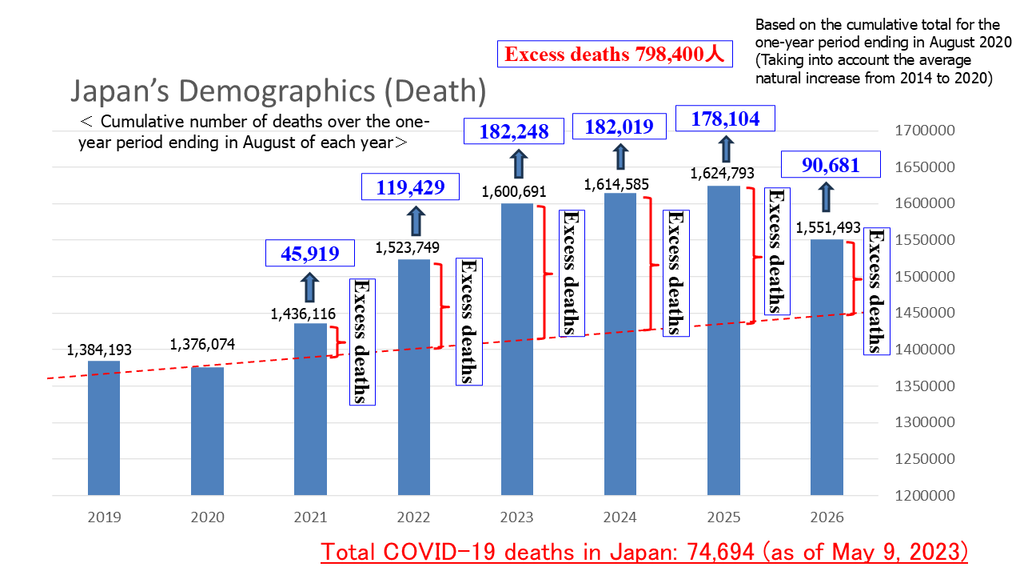
- 2026年10月25日、厚生労働省から2026年8月分の人口動態統計速報が公表され、2026年8月までの過去12か月間の死亡数は1,551,493人となった。図に示すように、2020年8月までの過去12か月間の死亡数1,376,074人と比較すると、2021年以降の死亡数は大きく増加し、2022年から2025年にかけては150万~160万人台で推移した。ただし、2026年には前年より減少している。
この死亡数の増加については、人口の高齢化、COVID-19による直接的・間接的な影響、医療機関への受診状況の変化、老衰、循環器疾患、肺炎などの死因の変化を含め、複数の要因を検討する必要がある。単純な死亡数の前年比較だけでは、人口構造の変化による死亡増加と、統計的に推定された超過死亡を区別することはできない。超過死亡を評価するためには、年齢構成、長期的な死亡率の推移、季節性、感染症、気温などを考慮して、予測される死亡数を適切に推定する必要がある。
また、2021年以降の死亡数増加とCOVID-19ワクチン接種の時期が重なっていることから、ワクチンとの関連を指摘する研究や意見も存在する。一方で、時間的な一致だけからワクチンが超過死亡の原因であると判断することはできない。ワクチン接種と死亡との因果関係を検証するためには、接種者と未接種者の比較、年齢・性別・基礎疾患・COVID-19感染歴などを調整した疫学研究、死因別分析、接種後死亡例の個別調査や病理学的検討など、多方面からの検証が必要である。
政府は、COVID-19による死亡だけでなく、超過死亡を含む死亡数の変化について、その原因を可能な限り詳細に分析し、透明性の高い情報公開を行うことが重要である。ワクチンの有効性を評価することと、安全性や健康被害の可能性を検証することは両立する。国民の生命と健康を守るためには、ワクチンに対する賛否を先に決めるのではなく、科学的データに基づいて利益とリスクを継続的に評価し、その結果を社会で共有する姿勢が求められる。
03-23: On August 28, 2026, the Ministry of Health, Labour and Welfare released the preliminary monthly vital statistics report for June 2026, indicating that the total number of deaths in Japan over the 12-month period leading up to June 2026 reached 1,547,818. As shown in the figure, compared to 1,377,664 deaths recorded in the 12-month period ending in June 2020, annual fatalities increased substantially from 2021 onward, hovering between 1.5 and 1.6 million per year from 2022 to 2025. However, a slight decline was observed in 2026 relative to the preceding year.
Analyzing this surge in mortality requires evaluating multiple intersecting factors, including population aging, direct and indirect impacts of COVID-19, shifts in healthcare-seeking behaviors, and changing causes of death such as senility, cardiovascular diseases, and pneumonia. A simple year-over-year comparison of crude death counts cannot distinguish between mortality increases driven by demographic shifts and statistically estimated excess mortality. Assessing true excess mortality necessitates establishing appropriate baseline projections that account for age structure, long-term mortality trends, seasonality, infectious disease dynamics, and ambient temperature.
Furthermore, because the post-2021 increase in mortality coincided temporally with the rollout of COVID-19 vaccination, several studies and commentators have suggested a potential correlation. However, temporal coincidence alone does not establish vaccination as the cause of excess mortality. Verifying a causal link between vaccination and mortality requires multifaceted scientific investigation, including comparative cohort studies between vaccinated and unvaccinated populations adjusted for age, sex, comorbidities, and prior COVID-19 infection history, cause-specific mortality analyses, individual case evaluations of post-vaccination deaths, and histopathological examinations.
It is crucial for the government to perform detailed analyses of mortality dynamics—including excess mortality beyond direct COVID-19 deaths—and to maintain high transparency in public data disclosure. Evaluating vaccine efficacy and verifying safety or potential adverse outcomes are mutually reinforcing, not mutually exclusive. Safeguarding public life and health demands an objective stance that continuously evaluates benefits and risks based on empirical scientific data and shares these insights openly across society, rather than taking a dogmatic stance for or against vaccination.
< data: https://www.mhlw.go.jp/toukei/list/81-1a.html >
- 「太陽活動は感染症にどのような影響を与えるのか?」
太陽活動が活発になると黒点が増加する傾向がある。黒点は太陽の磁気活動を示す重要な指標であり、黒点数が増える時期には、紫外線、極端紫外線(EUV)、X線などの放射や、太陽フレアに伴う高エネルギー粒子なども変化する。太陽全体の総放射量の変化は比較的小さい一方、特定の短波長放射では相対的に大きな変動が生じることが知られている。
これらの変化のうち、特に紫外線は皮膚を介して人体の免疫系を調節することが知られている。紫外線は免疫反応を単純に強めたり弱めたりするのではなく、抗原提示、サイトカイン、T細胞など複数の経路を通じて、免疫抑制と免疫調節の双方に作用する。したがって、紫外線の増加が感染症を一律に増加させるとは限らず、病原体や感染経路、季節、気温、湿度などを含めて考える必要がある。
一方、太陽活動に伴うEUVやX線は、地球の上層大気に強く吸収される。また、高エネルギー粒子も地球磁場と大気によって遮蔽されるため、通常の地上生活において太陽活動の変化によるこれらの放射線が人体へ直接大きな影響を及ぼすことは考えにくい。むしろ、これらは電離層や上層大気を変化させることで、間接的に地球環境へ影響する可能性を考える必要がある。
したがって現代科学においては、太陽放射、とりわけ紫外線などが人体の免疫系を調節することは確認されているものの、太陽活動の約11年周期の変動が感染症の流行を増加させるという因果関係は確立されていない。実際には、太陽放射、気候、病原体、人間の行動、免疫状態など複数の要因が相互に作用している可能性があり、今後さらに生理学的・疫学的研究を進める必要がある。
一方、本書では、現時点の科学では物理量として十分に定義・測定されていない霊的(量子情報的)側面についても考察する。太陽活動の増大に伴う「火素」の変化が地球の量子情報場に作用し、それが人体の霊的(量子情報的)側面に影響するという考え方は、現代科学によって確立された理論ではない。しかし、本書ではこれを一つの仮説として位置付け、既知の物理・生理学的作用とは区別した上で、今後検証すべき研究課題として考察していくのである。
03-24: ‘How does solar activity influence infectious diseases?’
When solar activity becomes active, sunspots tend to increase. Sunspots are crucial indicators of solar magnetic activity; during periods of elevated sunspot numbers, emissions such as ultraviolet (UV), extreme ultraviolet (EUV), and X-rays, as well as high-energy solar energetic particles accompanying solar flares, undergo significant fluctuations. While variations in total solar irradiance (TSI) across the entire spectrum remain relatively small, substantial relative fluctuations are known to occur in specific short-wavelength radiation.
Among these radiation components, ultraviolet radiation in particular is known to modulate the human immune system via the skin. UV radiation does not simply strengthen or suppress immune responses in a binary fashion; rather, it acts upon both immunosuppression and immunomodulation through multiple pathways involving antigen presentation, cytokines, and T cells. Consequently, an increase in UV radiation does not uniformly increase infectious disease incidence, necessitating a comprehensive evaluation that accounts for pathogens, transmission routes, seasonality, temperature, and humidity.
Conversely, EUV and X-rays associated with solar activity are strongly absorbed by Earth’s upper atmosphere. Furthermore, high-energy particles are shielded by Earth’s magnetic field and atmosphere, making it unlikely that variations in these radiation types exert a direct, major impact on human physiology during routine terrestrial life. Instead, their potential indirect impacts on the terrestrial environment must be evaluated through their capacity to alter the ionosphere and upper atmosphere.
Thus, in modern natural science, while it is confirmed that solar radiation—particularly UV—modulates the human immune system, a definitive causal relationship establishing that the ~11-year solar activity cycle directly increases infectious disease epidemics remains unestablished. In reality, multiple interacting factors—including solar radiation, climate, pathogen dynamics, human behavior, and immunological status—are likely operating simultaneously, requiring further physiological and epidemiological research.
Meanwhile, this book examines spiritual (quantum-informational) dimensions that are not yet fully defined or measured as physical quantities within current scientific paradigms. The concept that increases in quantum energy (‘Haso’ or the spiritual element of fire) accompanying solar activity act upon Earth’s quantum information field and subsequently influence the spiritual (quantum-informational) aspects of living organisms is not a theory established by mainstream science. Nevertheless, this book positions this concept as a working hypothesis, strictly distinguishing it from established physical and physiological mechanisms, and framing it as a critical research question for future empirical verification.
- 「太陽活動と地震の関係について」
過去の太陽活動と地震活動の発生時期を比較すると、両者の間に何らかの関係がある可能性を指摘する研究が存在する。一方で、太陽活動や地磁気活動が地震を引き起こすという因果関係は、現在の科学では確立されていない。したがって、両者の時間的な対応が偶然なのか、それとも何らかの太陽‐地球間相互作用によるものなのかについて、さらに統計的・地球物理学的な検証が必要である。
太陽活動は太陽黒点数と密接に関係しているが、黒点数は太陽活動そのものではなく、その磁気活動を表す代表的な指標の一つである。したがって、太陽活動の強弱を考察する際には、単純に黒点数の多い少ないだけを見るのではなく、約11年周期における黒点活動の振幅、さらに約100年規模で変化する周期強度など、複数の時間スケールを考慮する必要がある。
さらに本書では、約11年周期の活動強度が約100年規模で変動し、その約100年規模の変動そのものも、より長い数千年規模の変動によって変調される可能性を仮説として考察する。このような階層的な周期構造を想定すれば、現在の太陽活動についても、単一の11年周期だけではなく、より長期的な変動の中に位置付けて考えることができる。
ただし、数千年規模の太陽活動変動については現在も研究途上であり、近年の研究では、過去の放射性炭素などに見られる数千年規模の変動の一部が、太陽活動ではなく地球磁場の変化によって説明できる可能性も示されている。したがって、「現在は数千年規模の太陽活動の振幅が増大している」という見方は、現時点では確立した科学的事実ではなく、本書が提示する仮説として扱う必要がある。
その上で、もし現在が太陽活動の長期的な活動期に位置しているのであれば、その変動が太陽風、地磁気、地球大気などを介して地球環境にどのような影響を及ぼすのか、さらに地震活動との間に統計的・物理的な関係が存在するのかを検証することは重要な研究課題となるのである。
03-25:’On the Relationship Between Solar Activity and Seismic Activity’
When comparing historical solar activity with the occurrence of seismic activity, certain studies suggest the existence of a potential relationship between the two. However, a definitive causal relationship establishing that solar activity or geomagnetic activity triggers earthquakes remains unestablished within current scientific paradigms. Consequently, further statistical and geophysical verification is required to determine whether the temporal alignment between these phenomena represents a mere coincidence or an underlying solar-terrestrial interaction.
Solar activity is intimately related to sunspot numbers; however, sunspot numbers do not constitute solar activity in its entirety, but rather serve as a representative index of solar magnetic activity. Therefore, when evaluating the intensity of solar activity, it is necessary to consider multiple time scales—not merely looking at the raw count of sunspots, but also accounting for the amplitude of sunspot activity within its ~11-year cycle, as well as cycle-intensity fluctuations that vary over centennial scales.
Furthermore, this book posits the hypothesis that cycle intensities occurring on ~11-year scales fluctuate over ~100-year scales, and that these centennial-scale fluctuations are themselves modulated by longer, millennial-scale variations. By assuming such a hierarchical periodic structure, current solar activity can be contextualized not merely as a single 11-year cycle, but within a broader framework of long-term variations.
However, millennial-scale solar variability remains an active area of ongoing research. Recent studies indicate that a portion of the millennial-scale variations observed in historical radiocarbon (14C) data may be explained by changes in Earth’s intrinsic geomagnetic field rather than solar activity alone. Consequently, the perspective that ‘we are currently in an era of expanding amplitude in millennial-scale solar activity’ should be treated not as an established scientific fact, but as a working hypothesis presented in this book.
Nevertheless, if current solar activity is indeed situated within a long-term active phase, verifying how such variations influence the terrestrial environment via the solar wind, geomagnetism, and the atmosphere—and whether statistical or physical relationships exist between solar variations and seismic activity—represents a paramount research imperative.
- 1700年以降のM8以上の巨大地震の発生頻度を比較すると、1700年代、1800年代に比べ、1900年代以降には多くの巨大地震が記録されている。特に1950年代から60年代にかけては、1952年カムチャツカ地震(M9.0)、1957年アリューシャン地震(M9.1)、1960年チリ地震(M9.5)、1964年アラスカ地震(M9.2)というM9クラスの巨大地震が相次いで発生している。この時期は、太陽活動が非常に活発であった時期とも重なっている。
また、2000年から2024年までの25年間にも、M8以上の巨大地震が多数記録されている。ただし、古い時代ほど地震観測網が未発達で、過去の巨大地震には記録漏れやマグニチュード推定の不確実性があるため、年代による発生件数の単純比較だけから、近代になって巨大地震そのものが増加したと断定することはできない。
一方、太陽活動と地震活動との間に統計的な関係がある可能性を指摘する研究も存在するものの、太陽活動が巨大地震を引き起こすという因果関係は、現在の科学では確立されていない。そこで本書では、太陽活動の約11年周期だけでなく、それを変調する約100年規模、さらに数千年規模の長期変動に着目し、太陽活動の長期的な振幅変動が地球の地震活動に何らかの影響を与える可能性について、仮説として考察するのである。
03-26: Comparing the frequency of megathrust earthquakes of magnitude 8.0 or greater since 1700 reveals that significantly more megathrust events were recorded during and after the 1900s than in the 1700s or 1800s. In particular, from the 1950s through the 1960s, a sequence of M9-class megathrust earthquakes occurred in rapid succession: the 1952 Kamchatka earthquake (M9.0), the 1957 Andreanof Islands earthquake (M9.1), the 1960 Great Chilean earthquake (M9.5), and the 1964 Good Friday earthquake in Alaska (M9.2). This period coincided temporally with an era of exceptionally active solar behavior.
Furthermore, during the 25-year period from 2000 through 2024, numerous earthquakes of M8.0 or greater were recorded. However, because seismic observation networks were underdeveloped in earlier eras, historical megathrust records are subject to missing data and uncertainties in magnitude estimation. Consequently, it cannot be definitively concluded based solely on raw chronological counts that the absolute frequency of megathrust earthquakes has increased in modern times.
Meanwhile, although certain studies point to the possibility of a statistical correlation between solar activity and seismic events, a direct causal relationship establishing that solar activity triggers megathrust earthquakes remains unestablished in contemporary science. Therefore, this book focuses not only on the ~11-year solar cycle but also on its modulating centennial-scale and millennial-scale long-term variations, examining as a working hypothesis the possibility that long-term fluctuations in solar activity amplitude exert an influence on terrestrial seismic activity.
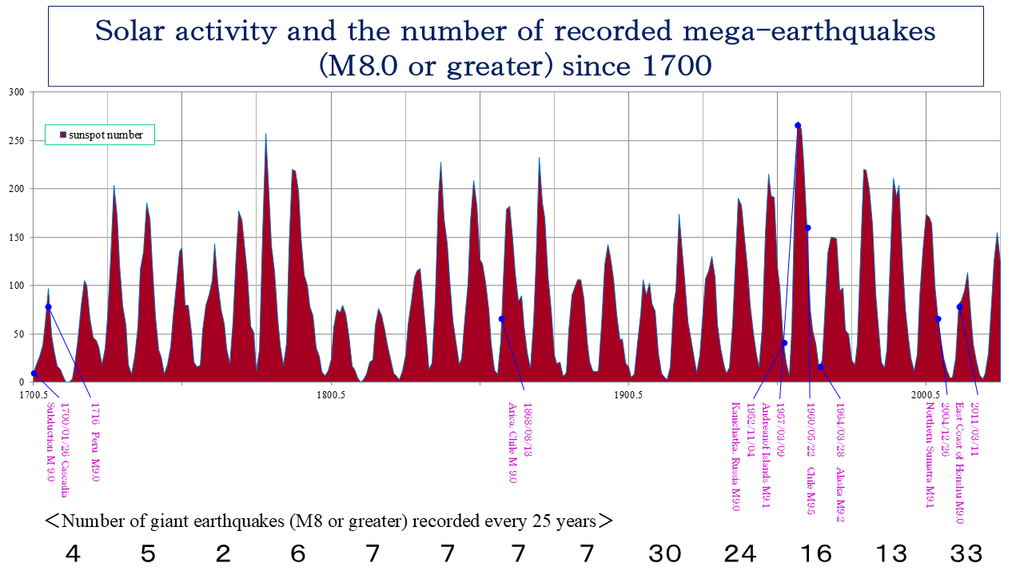
- 1950年代から60年代にかけては、1952年カムチャツカ地震(M9.0)、1957年アリューシャン地震(M9.1)、1960年チリ地震(M9.5)、1964年アラスカ地震(M9.2)というM9クラスの巨大地震が相次いで発生している。ただし、これら4つの地震がすべて太陽黒点の極大期(シュワーベ周期)に発生したわけではない。このことから、巨大地震の発生を約11年周期の太陽黒点数だけで説明することはできないと考えられる。
一方、これら4つの巨大地震はいずれも環太平洋地震帯の海溝付近に位置する沈み込み帯で発生している。環太平洋地域は、海洋プレートが他のプレートの下に沈み込む境界が集中しており、世界最大級の地震が発生する地域である。このことから、これらの巨大地震の直接的な背景には、プレートの沈み込みによって長期間蓄積された応力の解放があると考えられる。
ただし、なぜ特定の時期に巨大地震が集中するのかという問題については、さらに検討する必要がある。太陽活動との関係を考える場合、単純な黒点数の極大・極小だけではなく、約11年周期を変調する約100年規模、さらに長期的な太陽活動の変動が、地球の電磁・磁気環境や地球内部のダイナミクスに何らかの影響を与え、すでに応力が蓄積しているプレート境界における地震発生のタイミングに作用する可能性について、仮説として検証する必要があるのである。
03-27: From the 1950s through the 1960s, a sequence of M9-class megathrust earthquakes occurred in rapid succession: the 1952 Kamchatka earthquake (M9.0), the 1957 Andreanof Islands earthquake (M9.1), the 1960 Great Chilean earthquake (M9.5), and the 1964 Good Friday earthquake in Alaska (M9.2). However, not all four of these megathrust earthquakes occurred during peak phases of the ~11-year sunspot cycle (Schwabe cycle). This indicates that the temporal occurrence of megathrust earthquakes cannot be explained solely by the ~11-year sunspot cycle.
Meanwhile, all four of these megathrust earthquakes occurred within subduction zones located along the trenches of the Pacific Rim. The Circum-Pacific Belt represents a concentration of convergent boundaries where oceanic plates subduct beneath adjacent plates, serving as the primary locus for the world’s largest earthquakes. Consequently, the direct background of these megathrust events is rooted in the long-term accumulation and sudden release of tectonic stress driven by plate subduction.
Nevertheless, the question of why megathrust earthquakes clustered during this specific historical window warrants further investigation. When evaluating potential relationships with solar activity, it is necessary to test the working hypothesis that rather than simple sunspot maxima or minima, centennial-scale and longer-term modulations of the ~11-year cycle influence Earth’s electromagnetic and geomagnetic environment as well as internal geodynamics, thereby acting upon the timing of rupture in plate boundaries where tectonic stress has already reached critical levels.
- 現代科学では、太陽活動に伴う太陽風、磁場、電磁放射などの変化が、地球の磁気圏や電離圏、大気に影響を及ぼすことが明らかになっている。一方、太陽活動が地球内部、特にプレート運動や地震活動にどの程度影響を及ぼすのかについては、まだ十分に解明されていない。
本書では、これを量子情報論の観点から考察する。すなわち、太陽と地球は単に電磁的・重力的に相互作用しているだけでなく、両者を構成する物質の量子状態の間にも、何らかの量子的な相関が存在する可能性があるのではないかと考えるのである。量子もつれそのものは、光子、電子など様々な量子系において実験的に確認されている。しかし、巨大な天体を構成する膨大な量子系の内部情報が、天体間の量子的な結びつきによって相互に反映されることは、現在の科学では実証されていない。
また、重力については、これを量子化し、グラビトンなどの量子によって記述しようとする理論が研究されているが、グラビトンそのものはまだ実験的に確認されていない。したがって、天体の質量に関する情報が量子的な相関を通じて重力として現れるという考えは、現段階では仮説の領域にある。さらに本書では、重力だけでなく、天体内部に存在する様々な量子情報についても、天体間の量子的な相関を通じて何らかの影響が生じている可能性があるのではないかと考察するのである。
03-28: In modern science, it is well established that variations in solar activity—such as the solar wind, magnetic fields, and electromagnetic radiation—impact Earth’s magnetosphere, ionosphere, and upper atmosphere. Conversely, the extent to which solar activity influences Earth’s internal dynamics, particularly plate tectonics and seismic activity, remains insufficiently understood.
This book addresses this question from the perspective of quantum information theory. Specifically, we consider the possibility that solar and terrestrial systems interact not merely through electromagnetic and gravitational channels, but also via underlying quantum correlations between the quantum states of the matter comprising these celestial bodies. Quantum entanglement itself has been experimentally verified in various microscopic quantum systems, such as photons and electrons. However, it has not been empirically demonstrated in contemporary physics that the internal information of vast quantum ensembles comprising macroscopic celestial bodies is mutually reflected through inter-astrophysical quantum connections.
Regarding gravitation, theoretical research continues toward quantizing gravity and describing gravitational interactions via force-mediating quanta such as gravitons; however, gravitons themselves have yet to be experimentally confirmed. Consequently, the concept that information regarding the mass of celestial bodies manifests as gravity through quantum correlations remains, at present, within the realm of hypothesis. Furthermore, this book posits that beyond mass and gravity, various forms of quantum information embedded within celestial interiors may exert mutual influences through inter-astrophysical quantum correlations.

- 大地震の発生時期と満月・新月などの月齢との関係については、地球潮汐の観点から研究が行われている。月と太陽の引力は海水だけでなく地球そのものにも作用し、地球の固体部分を周期的に変形させている。この現象を地球潮汐という。満月や新月の前後には、太陽と月の潮汐作用が重なって大きくなるため、地球内部の応力も変化する。
地球潮汐による応力は、プレート運動によって断層に長期間蓄積される応力に比べれば非常に小さい。しかし、すでに破壊直前まで応力が蓄積した断層では、このような微小な応力変化が地震発生の最後の引き金となる可能性が指摘されている。実際、沈み込み帯や一部の断層では、潮汐応力と地震発生時期との統計的な関係を示す研究が報告されている。一方で、すべての地震が満月や新月に発生するわけではなく、潮汐による地震誘発の効果は地震の種類や断層の状態によって異なると考えられている。
例えば、1995年1月17日の阪神・淡路大震災は満月の日に発生し、2004年12月26日のスマトラ島沖地震についても、周辺で発生した地震と地球潮汐との間に関連が報告されている。これらは、月齢そのものが地震を引き起こしたことを意味するものではないが、太陽と月による周期的な重力作用が、地震発生の時期に影響を及ぼす可能性を考える上で興味深い事例である。
火山活動についても、一部の火山性地震と地球潮汐との関連を示す研究があることから、潮汐作用が火山活動のタイミングに何らかの影響を及ぼす可能性について、今後さらに検証する必要がある。
03-29: Studies have been conducted from the perspective of solid Earth tides regarding the relationship between the timing of major earthquakes and lunar phases, such as full moons and new moons. The gravitational forces of the Moon and the Sun act not only on ocean water but also on the Earth itself, periodically deforming the solid planet. This phenomenon is known as solid Earth tides. Around the times of full moons and new moons (syzygy), the tidal forces of the Sun and the Moon align and constructively reinforce each other, resulting in periodic fluctuations in internal terrestrial stress.
The incremental stress generated by solid Earth tides is exceedingly small compared to the tectonic stress that accumulates over long periods along faults due to plate motion. However, in faults where tectonic stress has already accumulated to near-critical failure thresholds, it has been suggested that such minute stress perturbations may serve as the final trigger for earthquake rupture. Indeed, studies on subduction zones and specific fault systems have reported statistical correlations between tidal stress and the timing of earthquake initiation. Conversely, not all earthquakes occur during full or new moons, indicating that the triggering effect of Earth tides varies depending on the earthquake type and the physical state of the fault.
For instance, the Great Hanshin-Awaji Earthquake on January 17, 1995, occurred on the day of a full moon, and studies have also reported associations between solid Earth tides and earthquakes surrounding the 2004 Sumatra-Andaman earthquake on December 26, 2004. While these cases do not imply that the lunar phase itself directly caused the earthquakes, they represent intriguing empirical examples when considering how periodic gravitational interactions exerted by the Sun and the Moon may influence the timing of seismic rupture.
Regarding volcanic activity as well, certain studies demonstrate correlations between specific volcanic earthquakes and solid Earth tides, warranting further empirical investigation into how tidal forces might influence the timing of volcanic eruptions and magmatic dynamics.


< data: https://j-jis.com/yochi/sun >
- 一方、太陽活動の変化は、総太陽放射量や紫外線などを通じて地球の大気に影響を及ぼしている。特に紫外線の変化は成層圏のオゾン生成や温度分布に作用し、それに伴う成層圏の大気循環の変化が、対流圏の大気循環や降水パターンに影響を及ぼす可能性が研究されている。
地球の大気循環は、赤道と極地方との温度差、海洋と大気の熱輸送、海面水温、温室効果ガス、火山活動、エルニーニョ・ラニーニャなどの自然変動など、多くの要因によって形成されている。これらの条件が変化すると、前線や低気圧の活動、台風や温帯低気圧の発達、偏西風やジェット気流の位置・蛇行などにも変化が生じる可能性がある。
大気循環が大きく変化すると、暖気や寒気の流入、前線や降水帯の停滞、低気圧の発達などが生じ、猛暑、寒波、豪雨、洪水、干ばつ、冷害、山火事などの極端な気象・気候現象につながることがある。実際に、近年観測されている高温や大雨などの極端現象には、人為的な気候変動が影響していることが確認されている。
ただし、太陽活動の変化が近年の地球温暖化や極端現象の主な原因であると断定することはできない。11年周期などに伴う太陽放射の変化は存在するものの、その影響は近年の人為的な温室効果ガスによる放射強制力に比べて小さい。IPCCは、近年の全球的な温暖化の主因が人為起源の温室効果ガスであると評価している。
一方で、太陽活動が大気・海洋循環や降水パターンなどの自然変動に一定の影響を及ぼす可能性は否定できない。特に、11年周期より長い時間スケールにおける太陽活動の変動が気候にどの程度影響するのかについては、他の自然変動や人為的要因と区別しながら、さらに検証する必要がある。
03-30: Meanwhile, variations in solar activity exert influences on Earth’s atmosphere primarily through changes in total solar irradiance (TSI) and ultraviolet (UV) radiation. In particular, fluctuations in UV radiation act upon stratospheric ozone production and thermal profiles; research is actively examining how the resulting changes in stratospheric circulation subsequently influence tropospheric circulation patterns and precipitation regimes.
Earth’s atmospheric circulation is shaped by a complex interplay of factors, including equator-to-pole thermal gradients, atmosphere-ocean heat transport, sea surface temperatures (SST), greenhouse gases, volcanic activity, and internal climate variability such as El Niño–Southern Oscillation (ENSO). When these boundary conditions shift, structural changes can occur in frontal activity, the intensification of tropical and extratropical cyclones, and the positioning or meanderings of the mid-latitude jet stream.
When atmospheric circulation undergoes major reorganizations, the influx of anomalous warm or cold air masses, the stagnation of frontal zones and precipitation belts, and the rapid intensification of low-pressure systems can manifest as extreme weather and climate events—including heatwaves, cold surges, torrential rainfall, floods, droughts, severe cold damage, and wildfires. Indeed, it has been empirically confirmed that anthropogenic climate change exerts an influence on the extreme heat and heavy rainfall events observed in recent years.
However, it cannot be concluded that solar variability constitutes the primary driver of recent global warming or climate extremes. Although variations in solar irradiance associated with the ~11-year cycle exist, their radiative forcing is significantly smaller than the radiative forcing driven by anthropogenic greenhouse gas emissions in recent decades. The Intergovernmental Panel on Climate Change (IPCC) assesses that anthropogenic greenhouse gas emissions represent the dominant cause of recent global warming.
Nevertheless, the possibility that solar activity exerts a discernible influence on natural climate variability—such as atmospheric and oceanic circulation patterns and regional precipitation—cannot be ruled out. In particular, determining the extent to which solar fluctuations operating on time scales longer than the ~11-year cycle impact climate dynamics represents an essential research imperative that requires careful isolation from other natural and anthropogenic drivers.

- 太陽活動については、ベルギー王立天文台のWDC-SILSOをはじめとする太陽観測・解析機関や国際的な観測ネットワークによって、将来の活動周期や黒点数の予測が行われている。太陽黒点は平均約11年周期で増減するため、過去の観測記録、太陽磁場の状態、統計モデル、物理モデルなどを用いて、次の活動極大期の時期や強さを推定することができる。ただし、太陽活動の周期は毎回一定ではなく、予測には不確実性がある。
実際、第25太陽活動周期についても、当初の予測とその後の観測結果には差が生じ、予測は観測結果に応じて更新されてきた。これは最初に述べた通り、約11年のシュワーベ周期、約100年規模のグライスベルグ型変動、さらに数百年から数千年規模の長期的変動など、異なる時間スケールの変動を考慮しながら、継続的な科学的観測結果に基づいて太陽活動を予測していく必要があることを示している。
03-31: Regarding solar activity, international solar observation and analysis agencies—including WDC-SILSO at the Royal Observatory of Belgium—along with global observation networks, regularly generate forecasts for future solar activity cycles and sunspot numbers. Because sunspot numbers fluctuate on an average ~11-year cycle, researchers estimate the timing and intensity of upcoming solar maxima by combining historical observational records, solar magnetic field dynamics, statistical models, and physical dynamo simulations. However, the period and amplitude of solar cycles are not strictly uniform, imparting inherent uncertainties to long-term predictions.
Indeed, with respect to Solar Cycle 25, noticeable discrepancies emerged between initial predictions and subsequent observational outcomes, necessitating ongoing revisions of forecast models as empirical data accumulated. As emphasized from the outset, this highlights the essential requirement to predict solar activity continuously on the basis of empirical observations, while comprehensively accounting for variations across distinct time scales—including the ~11-year Schwabe cycle, centennial Gleissberg-type fluctuations, and longer millennial-scale variability.

< data: https://www.sidc.be/silso/home >
- 第2章『神々の実相論』で説明したが、本書では、1931年6月15日を境に、それまで約3000年間続いた『夜の時代』が終わり、『昼の時代』に転換したと捉えている。岡田茂吉師は、それについて次のように述べられている。『昼の世界ということは、黒点が変化するのです。』『学問の方では十一年目に黒点が強く現われるという事になっていますが……太陽もやはり呼吸運動が行われているのです。十一年目に一回行うのです。拡がったり、つぼまったりする呼吸です。』『十一年目に一度、百年目に一度、千年に一度、という大きなものもあります。』『凡て夜昼の区別があるように、大体一年、十年、百年、千年、万年、というように定期的に決まっているのです。今度昼間の世界になったのは三千年目になるのです。……三千年で一回転するのです。』『夜の期間中は宗教は固より、何も彼も徹底的に見えないのは当然で、それが為人間は迷いを生じ、真の安心立命は得られなかったのである。処が昼となるや天日の下、地上一切のものは明々白々に露呈されるので、分らないものはなくなる訳である。』これらは、本書では、高位の神霊(意識と情報体)から岡田茂吉師を通して1952年、1953年に示された情報として位置づけている。これらの内容は、現在の科学的な太陽活動モデルそのものを示すものではないが、約11年、約100年、さらに長期にわたる太陽活動の変動を考える上で、一つの仮説的な視点として参考になると考えるのである。
03-32: As elaborated in Chapter 2 (‘The Realms of Divine Spiritual Reality’), this book posits that June 15, 1931, marked the historical boundary at which the approximately 3,000-year ‘Era of Night’ reached its conclusion and transitioned into the ‘Era of Day.’ Regarding this epochal phase shift, Master Okada_Mokichi stated the following: ‘A world of day implies that sunspots undergo a transformation.’ ‘In academic science, it is understood that sunspots emerge strongly every 11 years… However, the Sun also undergoes a respiratory movement. It conducts this once every 11 years—a breathing process of expansion and contraction.’ ‘There are also grander cycles: once every 11 years, once every 100 years, once every 1,000 years.’ ‘Just as all things possess a distinction between night and day, periodic cycles are broadly determined—such as one year, ten years, a hundred years, a thousand years, and ten thousand years. The current entry into the world of daytime represents a 3,000-year cycle… completing a full revolution every 3,000 years.’ ‘During the Era of Night, it was natural that religion and all other phenomena remained thoroughly invisible in the dark; consequently, humanity fell into confusion and was unable to attain true peace of mind and enlightenment. However, as day arrives, all terrestrial things are exposed vividly beneath the sun, leaving nothing hidden or uncomprehended.’ In this book, these teachings are contextually positioned as information revealed through Master Okada_Mokichi by high-dimensional divine spiritual entities (conscious quantum information fields) between 1952 and 1953. While these dictations do not directly represent contemporary mathematical solar physics models in themselves, we submit that they offer a compelling hypothetical framework when examining multiscale variations in solar activity across 11-year, centennial, and long-term millennial scales.
- 今後の太陽活動について考察する。1700年代以降に観測されてきた太陽活動の長期的な変動を、仮に数千年規模の変動の初期段階と捉えるなら、今後さらに活動が強まる可能性も一つの仮説として考えられる。実際、20世紀には第16、第17、第18、第19太陽活動周期において比較的活発な周期が続き、第19周期では13か月平滑化月平均黒点数が285に達した。これらの過去の活動を参考に、本書では、第26~第28太陽活動周期において、黒点数が過去の活発な周期に匹敵し、あるいはそれを上回る活動が現れる可能性を長期的な仮説として想定する。また、さらに長期的なグライスベルグ型変動の極大時には、黒点数が月平均320程度に達する可能性も考えられる。ただし、これは現在の太陽物理学による確立した予測ではなく、過去の観測記録から本書が設定する仮説的なシナリオである。
太陽活動が強い時期には、太陽フレアやコロナ質量放出(CME)が増加し、1859年のキャリントンイベントのような極端な宇宙天気現象が発生する可能性もある。キャリントンイベントでは大規模な太陽フレアとCMEに伴う強い地磁気嵐が発生し、当時の電信網に大きな影響を与えたことが記録されている。 現代では、人工衛星、通信、測位、電力網など社会基盤への影響がさらに大きくなる可能性があり、特に低軌道衛星では熱圏の膨張による大気抵抗の増加も問題となる。 したがって、将来の太陽活動の強さを正確に予測することには不確実性があるとしても、極端な宇宙天気現象を想定した対策と準備を平時から進めておくことは重要であると考えるのである。
03-33: We now examine prospective scenarios for future solar activity. If the long-term variations in solar activity observed since the 1700s are conceptualized as the initial phase of a millennial-scale cycle, the possibility of even stronger solar activity in the future emerges as a viable working hypothesis. Indeed, the 20th century witnessed a sequence of exceptionally active cycles during Solar Cycles 16, 17, 18, and 19, with Cycle 19 attaining a 13-month smoothed monthly mean sunspot number of 285. Referencing these historical benchmarks, this book posits as a long-term hypothesis that Solar Cycles 26 through 28 may exhibit activity comparable to, or exceeding, these historical maximum levels. Furthermore, during the peak phase of a longer-term Gleissberg-type modulation, it is conceivable that monthly mean sunspot numbers could reach approximately 320. However, this scenario does not represent a deterministic prediction established by current solar physics, but rather a hypothetical projection formulated by this book based on historical observational records.
During periods of heightened solar activity, the frequency of solar flares and coronal mass ejections (CMEs) increases, elevating the probability of extreme space weather events akin to the 1859 Carrington Event. The Carrington Event produced intense geomagnetic storms driven by massive solar flares and CMEs, severely disrupting the telegraph networks of that era. In modern society, potential impacts on critical infrastructure—including artificial satellites, telecommunications, global navigation satellite systems (GNSS), and power grids—are vastly magnified. In particular, low-Earth orbit (LEO) satellites face severe operational hazards from increased atmospheric drag caused by thermospheric expansion. Consequently, notwithstanding the inherent uncertainties in precisely forecasting the intensity of future solar activity, it is imperative to proactively advance preparedness and mitigation measures for extreme space weather events as a matter of routine risk governance.

- 古代から東アジアの歴史において、三足烏は太陽の象徴として登場する。現代では、科学技術の進歩によって太陽は詳細に観測され、膨大なデータとともに、様々な種類の映像としてリアルタイムに提供されている。しかし、望遠鏡が存在しなかった古代においても、人々は太陽面に現れる大きな黒点を肉眼で観測していたことが、古代中国の記録から確認されている。実際、中国の史書には太陽の中に「黒子」「黒気」などが現れたという記録があり、大きさを卵や果実などにたとえた例も残されている。
03-34: Since antiquity, the three-legged crow (Sanzuowu/Yatagarasu) has appeared across East Asian history as a central symbol of the Sun. In the contemporary era, technological advancements enable continuous, high-resolution solar observations, delivering vast datasets alongside real-time multi-spectral imaging. However, long before the invention of the telescope, historical records from ancient China confirm that people observed large sunspots on the solar disk with the naked eye. Indeed, Chinese dynastic histories frequently record the appearance of ‘heizi’ (black spots) or ‘heiqi’ (black vapors) within the Sun, often employing metaphors comparing their size to eggs or fruits.
では、古代人が太陽の中に三足烏を描いたのは、何を意味するのであろうか。古代人が月に兎や蟾蜍(ヒキガエル)を見たというのは、月面の模様から想像力を働かせたものと考えられる。一方、太陽の中に黒い烏を見出した背景には、肉眼で観察された大型の太陽黒点が何らかの影響を与えた可能性も考えられる。大型黒点は現在でも太陽活動を示す重要な指標であり、歴史的な肉眼黒点の記録も過去の太陽活動を復元する資料として利用されている。
What, then, did ancient people intend when depicting a three-legged crow inside the Sun? While seeing rabbits or toads on the Moon likely derived from imaginative projections onto lunar surface crater markings (maria), the background of discovering a black bird within the Sun may have been directly influenced by exceptionally large sunspots observed with the naked eye. Giant sunspots remain a vital metric of solar activity in modern astrophysics, and historical naked-eye sunspot records are actively utilized today to reconstruct past solar activity levels.


黒点はしばしば複数の群として現れることから、古代人がその姿を黒い鳥の群れになぞらえた可能性もある。ただし、三足烏が太陽黒点そのものに由来するということは現在の歴史学・科学によって確定しているわけではなく、神話・図像・天文観測を結び付ける一つの仮説として考えるべきである。
Because sunspots frequently appear in complex clusters, ancient observers may have likened these groupings to flocks of black birds. Nevertheless, the assertion that the three-legged crow originates directly from solar sunspot morphology is not an established fact in modern historiography or solar physics; rather, it should be evaluated as a integrative working hypothesis bridging mythology, iconography, and observational astronomy.
太陽は、光や熱、昼夜、季節、農耕など、人間の生命と生活に直接関係する存在であった。その上に日食や大型黒点などの異常な太陽現象が加われば、人々が太陽を畏れ、神格化し、信仰の対象としたとしても不思議ではない。古代文明に太陽を神格化する信仰が広く見られることも、こうした太陽観を考える上で興味深い。
The Sun served as an existential foundation directly connected to human survival—governing light, heat, day-night cycles, seasonality, and agriculture. When anomalous solar phenomena such as solar eclipses or giant sunspots were superasserted onto this baseline, it was entirely natural for ancient populations to revere, deify, and worship the Sun. The widespread prevalence of solar cults across ancient civilizations represents a fascinating subject when examining human cosmic perceptions.
現代人は宇宙望遠鏡によって太陽黒点を詳細に観測しているが、古代人は肉眼によって太陽の異変を捉え、それを神話や象徴として後世に残したのかもしれない。もし将来、古代の記録に匹敵するほど巨大な黒点が肉眼で確認される時代が再び訪れるなら、それは太陽活動の大きな変化を示す現象として注目されることになるだろう。そして本書では、それを人類の新しい時代を考える一つの象徴として捉えてみたい。
While modern humans observe sunspots in meticulous detail using space telescopes, ancient humans captured solar anomalies through naked-eye perception and transmitted them to posterity as mythic symbols. If an era re-emerges in the future where giant sunspots comparable to ancient historical records become clearly visible to the naked eye, it will draw profound attention as a signal of major solar phase shifts. In this book, we interpret such an occurrence as a cosmic symbol reflecting humanity’s transition into a new era.
Copyright © 2026 solaract.jp. All Rights Reserved.